Benchmarking EWIE’s international pathway qualifications
How Ecctis independently evaluated the International Foundation Certificate and International Year One against qualifications frameworks in the UK and Australia.

CLIENT
East & West International Education Group
GEOGRAPHY
China, UK and Australia
PROJECT YEAR
2026
Independent qualification benchmarking
Clarity across education systems
Ecctis works with organisations around the world to bring clarity, confidence and transparency to the understanding of qualifications and education systems.
Through our independent evaluation and benchmarking services, we help education providers, awarding bodies, universities, professional bodies and government agencies understand how qualifications compare with national and international standards.
This provides evidence to support confident decision-making in education, training and skills development.
This case study outlines how Ecctis worked with East & West International Education Group (EWIE) to provide an independent, evidence-based evaluation of its International Foundation Certificate (IFC) and International Year One (IYO), supporting understanding of their educational level in relation to national qualifications frameworks in the UK and Australia.
About East & West International Education Group
An international education provider with more than two decades of experience supporting progression to international higher education.
Established in Beijing in 1999, East & West International Education Group is an international education provider specialising in the development and delivery of academic initiatives in partnership with universities in China and overseas.
EWIE has developed an extensive network of teaching and study centres across mainland China, working with partner universities to support students’ progression to international higher education.
Its International Curriculum for Undergraduate Education includes the International Foundation Certificate and International Year One, which form part of its wider pathway provision for students preparing for undergraduate study in English-speaking countries.
The brief
Project context and scope
EWIE commissioned Ecctis to undertake an independent evaluation and benchmarking of the IFC and IYO against the UK Regulated Qualifications Framework and Australian Qualifications Framework.
The IFC is a one-year foundation programme designed to prepare high school graduates for entry into undergraduate study in English-speaking countries, or for progression to the IYO.
The IYO is also a one-year programme. It provides a first-year undergraduate curriculum and aims to support entry to the second year of undergraduate study in English-speaking countries.
The purpose of the benchmarking exercise was to provide universities, employers, recognition agencies, students and other stakeholders with a clear indication of the overall level of both qualifications.
Ecctis evaluated the qualifications in relation to the UK Regulated Qualifications Framework and Australian Qualifications Framework, supported by consideration of similarly focused qualifications in the UK and Australia.
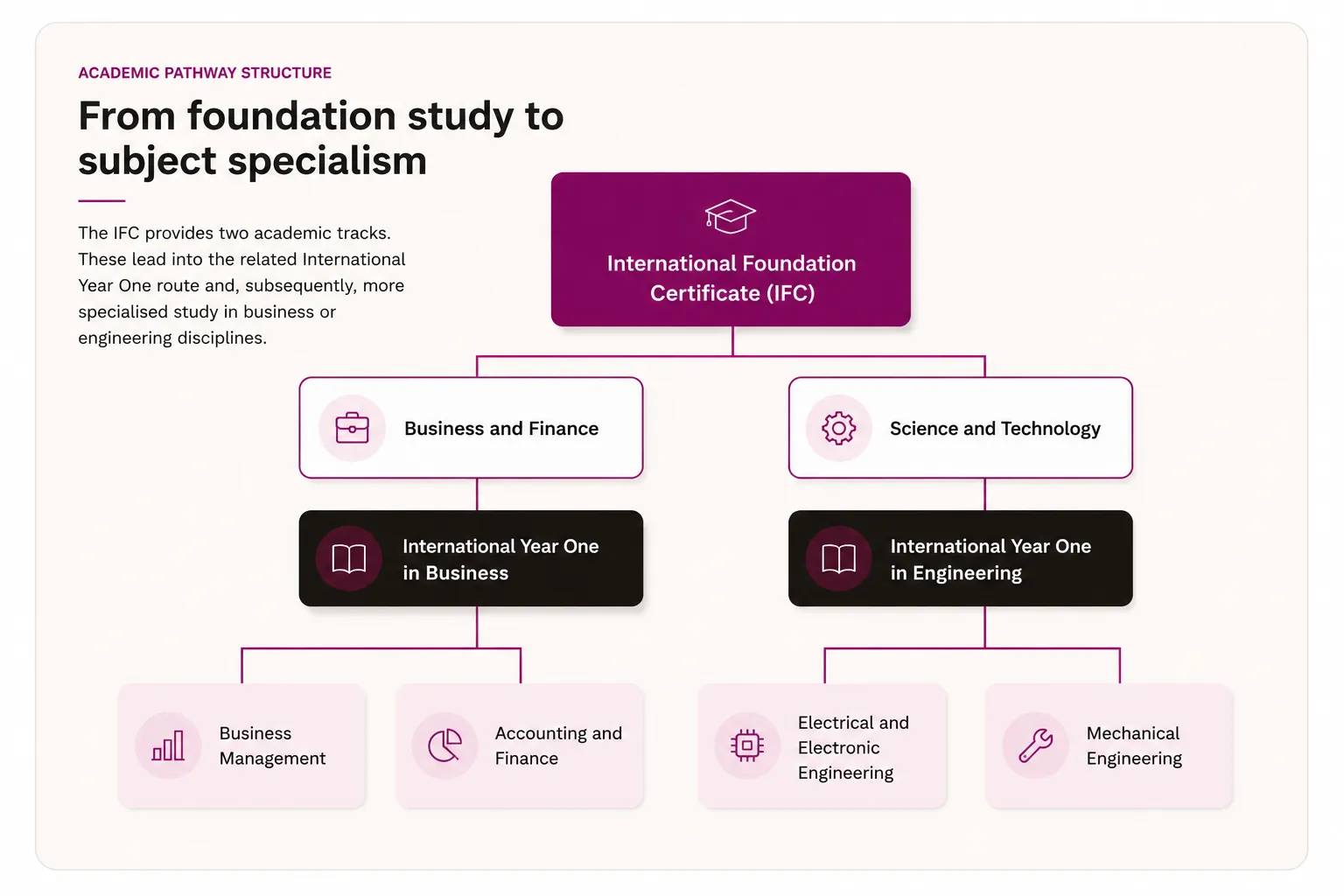
The IFC offers two academic tracks: Business and Finance, and Science and Technology. Students on the IYO initially follow either the IYO in Business or the IYO in Engineering before progressing to a subject specialism.
For the IFC, Ecctis considered comparator qualifications associated with entry to undergraduate study, including UK GCE A Levels and Australian Senior Secondary Certificates of Education.
For the IYO, Ecctis considered similarly focused pathway qualifications, including International Year One qualifications in the UK and Diploma qualifications offered by Australian universities.
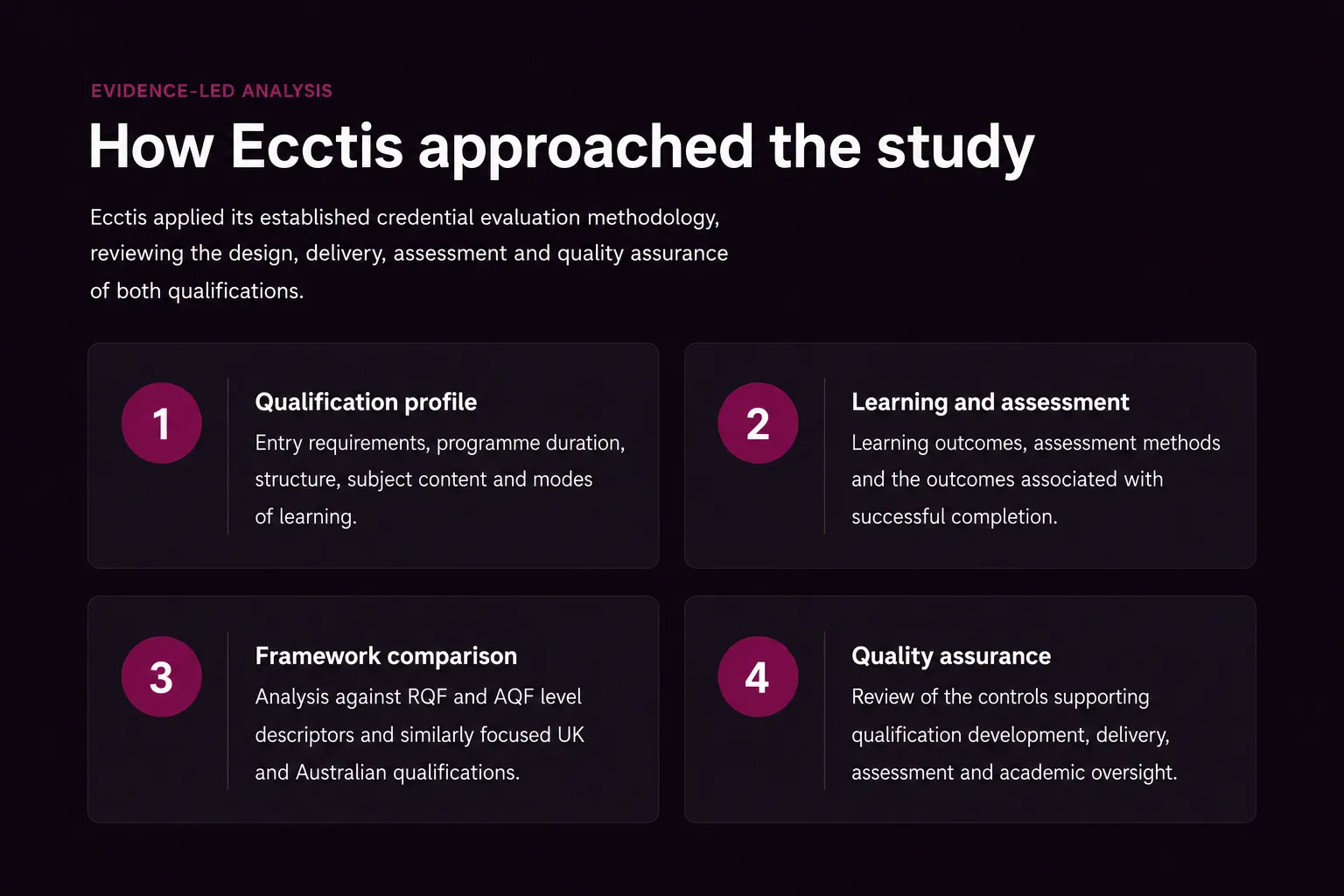
Ecctis reviewed both qualifications in terms of their entry requirements, duration, structure and content, modes of learning, learning outcomes, assessment methods and associated outcomes.
The quality assurance and control mechanisms underpinning the development, delivery and assessment of the IFC and IYO were also considered.
Core qualification components were reviewed against the RQF and AQF level descriptors. Samples of compulsory and elective modules were also analysed against similarly focused qualifications in the selected education systems.
This enabled Ecctis to consider whether the IFC and IYO provide comparable levels of knowledge, skills and competence to those expected in the UK and Australian contexts.
The benchmarking process was not intended to determine subject-for-subject equivalence. It provided an independent, evidence-based assessment of the overall level of each qualification in relation to recognised national frameworks and relevant comparator qualifications.
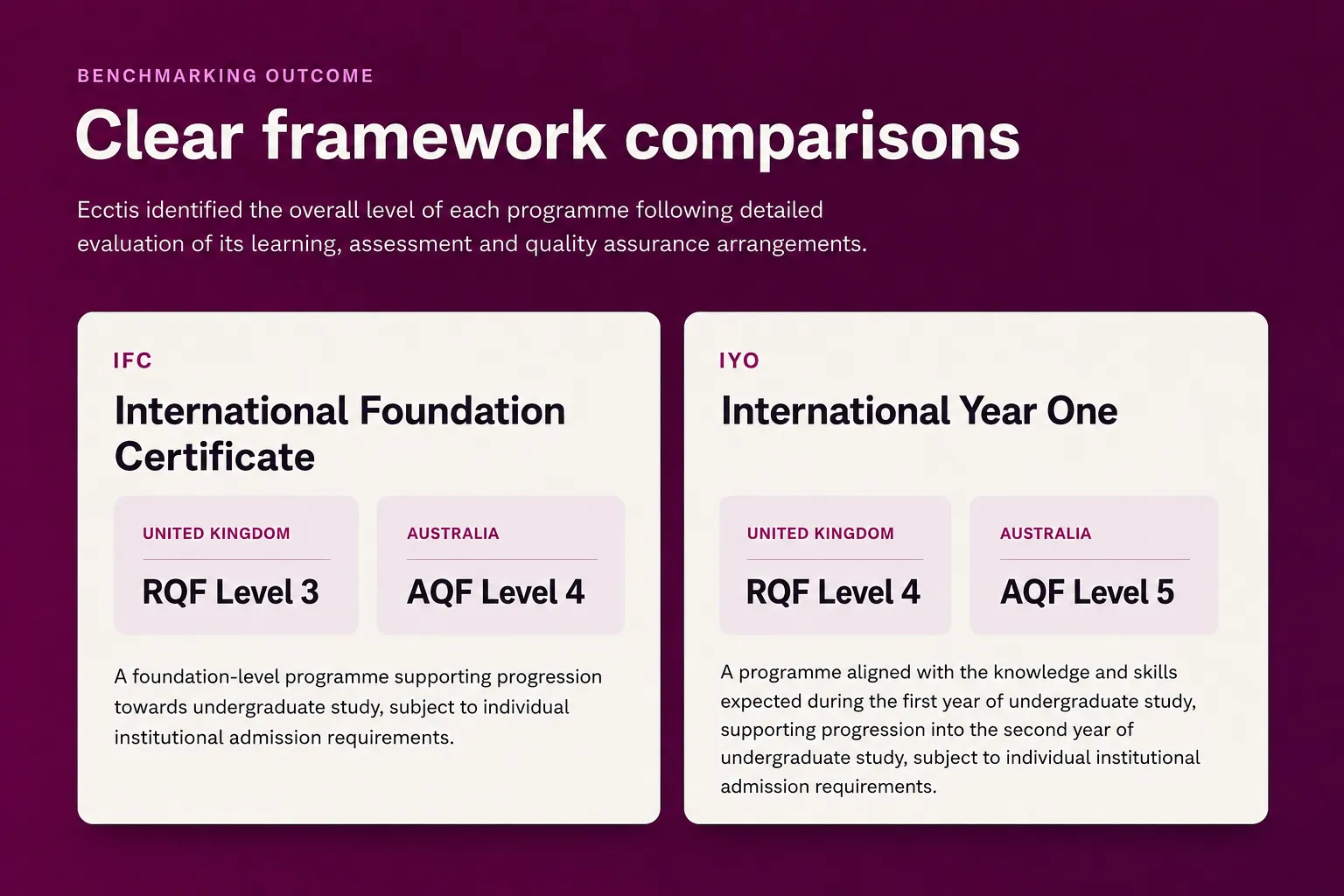
International Foundation Certificate
The IFC was found to provide a broad range of knowledge and skills, alongside English language and study skills development.
The IFC covers subject areas including mathematics, sciences, computing, business and engineering. Its content and learning outcomes require students to apply factual, procedural and theoretical knowledge to well-defined but sometimes complex problems, interpret and evaluate information, and communicate responses effectively.
Assessment methods including examinations, coursework and applied tasks were found to be appropriate for measuring the knowledge and skills expected at RQF Level 3 and AQF Level 4.
In its function of supporting progression to undergraduate study, the IFC also aligns with GCE A Levels and Australian Senior Secondary Certificates of Education, subject to individual institutional admission requirements.
International Year One
The IYO was found to deliver subject-specific knowledge and skills aligned with the first year of undergraduate study in business and engineering disciplines.
The IYO demonstrates clear progression from the IFC. Students are required to apply theoretical and technical knowledge to more complex and non-routine problems, analyse and evaluate information, and demonstrate increasing autonomy and judgement.
Assessment methods including coursework, extended written assignments, presentations and examinations were found to be appropriate for measuring the knowledge and skills expected at RQF Level 4 and AQF Level 5.
The increased use of coursework and applied assessment formats compares well with approaches used in similarly focused UK and Australian qualifications at these levels.
The IYO aims to support progression to the second year of undergraduate study in English-speaking countries, subject to individual institutional requirements. It therefore aligns with similarly focused pathway qualifications in the UK and Australia that provide advanced standing towards degree qualifications.
Quality assurance
Supporting consistent delivery
Ecctis also reviewed the procedures underpinning the development, delivery and assessment of the IFC and IYO.
EWIE’s quality assurance and control procedures are organised through a hybrid model of central academic oversight and delivery at established partner universities.
The policies and procedures in place were found to be sufficient for the purposes of confirming comparability to the RQF and AQF.
Project impact
Evidence to support stakeholder discussions
The findings provide EWIE with robust, independent evidence to support wider understanding of its pathway provision.
The findings provide EWIE with evidence to support discussions with partner universities, students and other stakeholders.
They also support wider understanding of EWIE’s international pathway provision in relation to established international qualifications frameworks.
Client perspective
An important milestone for EWIE
EWIE described the project as a significant step in the international development and long-term growth of its pathway provision.
We are delighted to share our sincere appreciation for Ecctis’s independent benchmarking of our International Foundation Certificate and International Year One programmes. This project was far more than a routine quality review; it marked an important milestone in the international development and long-term growth of our provision.
The evaluation has strengthened the foundation for our academic and technical talent development framework, helping align our assessment standards, curriculum design and academic specifications with UK and Australian undergraduate entry criteria. The independent findings have also expanded credible progression pathways for our students.
Throughout the project, Ecctis demonstrated outstanding academic expertise, rigorous cross-cultural coordination and deep insight into international foundation provision. We were impressed by its systematic, impartial and efficient assessment process, as well as the thoughtful, tailored support provided throughout every stage of the collaboration.
Deputy Director, EWIE International Curriculum Center
East & West International Education Group
Talk to us about qualification benchmarking
Independent, evidence-led analysis to help organisations understand how qualifications compare across education systems and national frameworks.

Ecctis is pleased to welcome education advocate Nicola de Iongh to its Board.
Nicola has been appointed as a statutory director of GRS (Holdings) Limited and Ecctis Limited, following a competitive recruitment process.
She is an experienced non-executive director and governance specialist, with significant leadership roles across higher education, healthcare and social housing.
Her current roles include Chair of Council at the University of Gloucestershire, Vice Chair and Senior Independent Director at Gloucestershire Health & Care NHS Foundation Trust, Senior Independent Director at Connexus Housing and Chair of the Committee of University Chairs, the representative body for UK university chairs.
Nicola also serves on the Lord Chancellor’s South West Advisory Committee for magistrate selection and is a Member of Court and Assistant Warden for the Honourable Company of Gloucestershire.
Previously, Nicola worked in the financial services sector as a global transformation lead. She also spent several years as a freelance management consultant, focusing on strategic and complex change across a range of sectors in the UK and Europe.
She brings strong governance expertise, strategic oversight and a clear focus on social impact, aligning with Ecctis’ purpose and values.
Nicola is passionate about the relationship between education, health and housing, and their role in driving change at an individual and community level.
Nicola de Iongh said: “I am delighted to be joining the Board of Ecctis, whose work sits at the heart of education, opportunity and international cooperation. At a time when skills, qualifications and mobility matter more than ever, Ecctis has a vital role in building trust across national boundaries. I very much look forward to meeting colleagues and playing my part in supporting this important mission.”
Susanna Whalley, Chair of the Board of GRS (Holdings) Limited and Ecctis Limited, added: “On behalf of the Board, I am delighted to welcome Nicola to Ecctis.
“She is an education advocate with a deep understanding of the role that trusted expertise plays in supporting individuals, institutions and governments around the world.
“Nicola’s experience in delivering strong governance, strategic oversight and social impact aligns closely with our organisation’s purpose and values.
“The Board looks forward to working closely with Nicola as we continue to build on Ecctis’ reputation for excellence, integrity and international collaboration.”
Establishing TNE in Malaysia

A practical guide for UK universities and higher education institutions on establishing and gaining accreditation for transnational education programmes and partnerships in Malaysia.
About this resource
As transnational education grows in importance within the UK Government’s Trade and International Education Strategies, demand for clearer pathways to recognition of UK awards is increasing. Malaysia is one of the UK’s most established TNE markets and has become a significant hub for both transnational education and international students.
For qualifications offered through TNE to be recognised in Malaysia and support graduate employability, particularly in the public sector, programmes must meet local regulatory requirements. Drawing on feedback from UK universities and supported by the Department for Business and Trade, Ecctis carried out a scoping exercise to explore the recognition process, barriers and opportunities in more detail.
This included in-country visits and engagement with stakeholders in both the UK and Malaysia, contributing to a joint action plan with the Department for Business and Trade and the Malaysian Qualifications Agency on the recognition of UK TNE qualifications. As part of this wider project, Ecctis has produced a guide to support UK higher education institutions considering or developing TNE arrangements in Malaysia.
What the guide covers
- Early market planning for UK institutions exploring TNE in Malaysia.
- The process for local approval and accreditation in-country.
- Key regulatory considerations, including local content requirements.
- Mapping to the Malaysian Qualifications Framework and wider recognition considerations.
- Practical issues such as professional recognition and institutional planning.
Summary
This resource is designed to give UK institutions a clearer, more practical route into understanding TNE establishment and recognition in Malaysia. It brings together policy context, operational considerations and practical guidance so institutions can approach partnership planning with greater confidence.
Credit conversion support
Credit conversion can be particularly complex in transnational education. To support institutions, Ecctis has also produced a credit conversion calculator and supporting guidance to help estimate how UK Bachelor’s and Master’s degree programmes may compare to MQF credits.
This tool is intended as guidance and should be used alongside the wider report and any relevant institutional or regulatory requirements.

Research on innovations in blended and online learning on the Secondary Teachers’ English Language Improvement Rwanda (STELIR) programme
Commissioned by the British Council in 2024, this project saw Ecctis evaluate the online stage of the STELIR programme in Rwanda. The research examined perceived effectiveness, quality of implementation, and equity and inclusivity, with particular attention to women teachers and teachers with disabilities, especially those with visual impairments. Drawing on international and local evidence alongside stakeholder engagement, the study generated practical insights to support more inclusive teacher training delivery.
Client: British Council
Country: Rwanda
Timescale: 2024
The STELIR course
After several significant shifts in language policy in Rwanda, since 2019 English has been used as the medium of instruction across the education system. This transition has been challenging for both teachers and learners, and research has highlighted the need for sustained English language training for teachers.
In 2022, the British Council launched the Secondary Teachers’ English Language Improvement Rwanda (STELIR) project, a three-year initiative designed to support in-service and pre-service Lower Secondary Teachers to strengthen their English language proficiency. STELIR is delivered in collaboration with Mastercard Foundation and implemented by the British Council in cooperation with the Rwanda Basic Education Board. The programme follows a blended learning model: stage one includes intensive in-person English language lessons delivered over one or two weeks depending on teachers’ language level; stage two includes asynchronous online self-study with weekly live sessions over 20 weeks on Webex; and stage three includes in-person CPD delivered in schools for in-service teachers and a peer-led professional development skills course for pre-service teachers. Before joining STELIR, teachers take the British Council’s Aptis English language proficiency test so the course can be matched to their current level. Results are measured against the Common European Framework of Reference for Languages (CEFR), ranging from A1 and A2 through to C1 and C2. Each language level is delivered over a full year, and participants who need further support can repeat the cycle until they reach B1 level.
Project context and scope
In 2024, the British Council commissioned Ecctis to conduct research into STELIR’s online stage, exploring its perceived effectiveness, quality of implementation, and equity and inclusivity in relation to women teachers and teachers with disabilities, particularly teachers with visual impairments.
Methodology
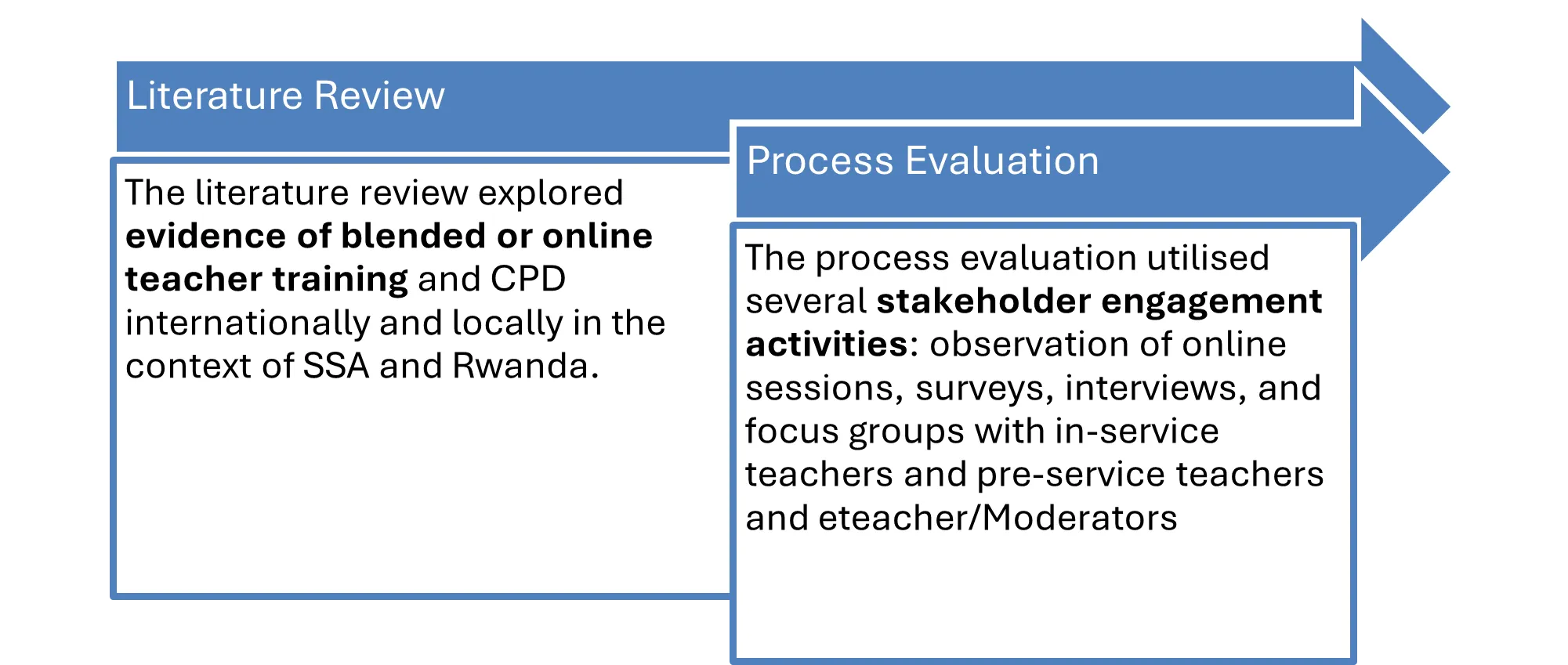
The study adopted a two-stage methodological approach. First, Ecctis conducted a literature review exploring evidence on blended and online teacher training and Continuous Professional Development (CPD) internationally and locally, with a particular focus on Rwanda and the wider Sub-Saharan African context. Second, Ecctis carried out a process evaluation through observations of online sessions, surveys, interviews, and focus groups with in-service and pre-service teachers, alongside eTeacher/Moderators delivering the online sessions. Data collection was undertaken in partnership with a research team from the Catholic University of Rwanda’s Faculty of Education.
Project outputs
The project produced two key deliverables: a commercial-in-confidence report presenting the findings and recommendations from the evaluation of STELIR, submitted to the British Council, and a journal article published in PRACTICE: Contemporary Issues in Practitioner Education.
The article explores in-service and pre-service teachers’ experiences of participating in STELIR’s online provision, with particular attention to women teachers and in-service teachers with disabilities. A focus on teachers with visual impairments was selected because visual impairment is the most prevalent disability type in Rwanda, according to information provided in the 2022 thematic report on the socio-economic characteristics of persons with disabilities, produced as part of the Fifth Population and Housing Census in Rwanda. The analysis was informed by gender studies theory, particularly Moser’s gendered triple role framework, and disability studies theory, particularly Oliver’s social model of disability. Together, these perspectives helped the study examine teachers’ experiences through both gender and disability lenses and share learning that can inform future inclusive teacher training initiatives.