
Research on innovations in blended and online learning on the Secondary Teachers’ English Language Improvement Rwanda (STELIR) programme
Commissioned by the British Council in 2024, this project saw Ecctis evaluate the online stage of the STELIR programme in Rwanda. The research examined perceived effectiveness, quality of implementation, and equity and inclusivity, with particular attention to women teachers and teachers with disabilities, especially those with visual impairments. Drawing on international and local evidence alongside stakeholder engagement, the study generated practical insights to support more inclusive teacher training delivery.
Client: British Council
Country: Rwanda
Timescale: 2024
The STELIR course
After several significant shifts in language policy in Rwanda, since 2019 English has been used as the medium of instruction across the education system. This transition has been challenging for both teachers and learners, and research has highlighted the need for sustained English language training for teachers.
In 2022, the British Council launched the Secondary Teachers’ English Language Improvement Rwanda (STELIR) project, a three-year initiative designed to support in-service and pre-service Lower Secondary Teachers to strengthen their English language proficiency. STELIR is delivered in collaboration with Mastercard Foundation and implemented by the British Council in cooperation with the Rwanda Basic Education Board. The programme follows a blended learning model: stage one includes intensive in-person English language lessons delivered over one or two weeks depending on teachers’ language level; stage two includes asynchronous online self-study with weekly live sessions over 20 weeks on Webex; and stage three includes in-person CPD delivered in schools for in-service teachers and a peer-led professional development skills course for pre-service teachers. Before joining STELIR, teachers take the British Council’s Aptis English language proficiency test so the course can be matched to their current level. Results are measured against the Common European Framework of Reference for Languages (CEFR), ranging from A1 and A2 through to C1 and C2. Each language level is delivered over a full year, and participants who need further support can repeat the cycle until they reach B1 level.
Project context and scope
In 2024, the British Council commissioned Ecctis to conduct research into STELIR’s online stage, exploring its perceived effectiveness, quality of implementation, and equity and inclusivity in relation to women teachers and teachers with disabilities, particularly teachers with visual impairments.
Methodology
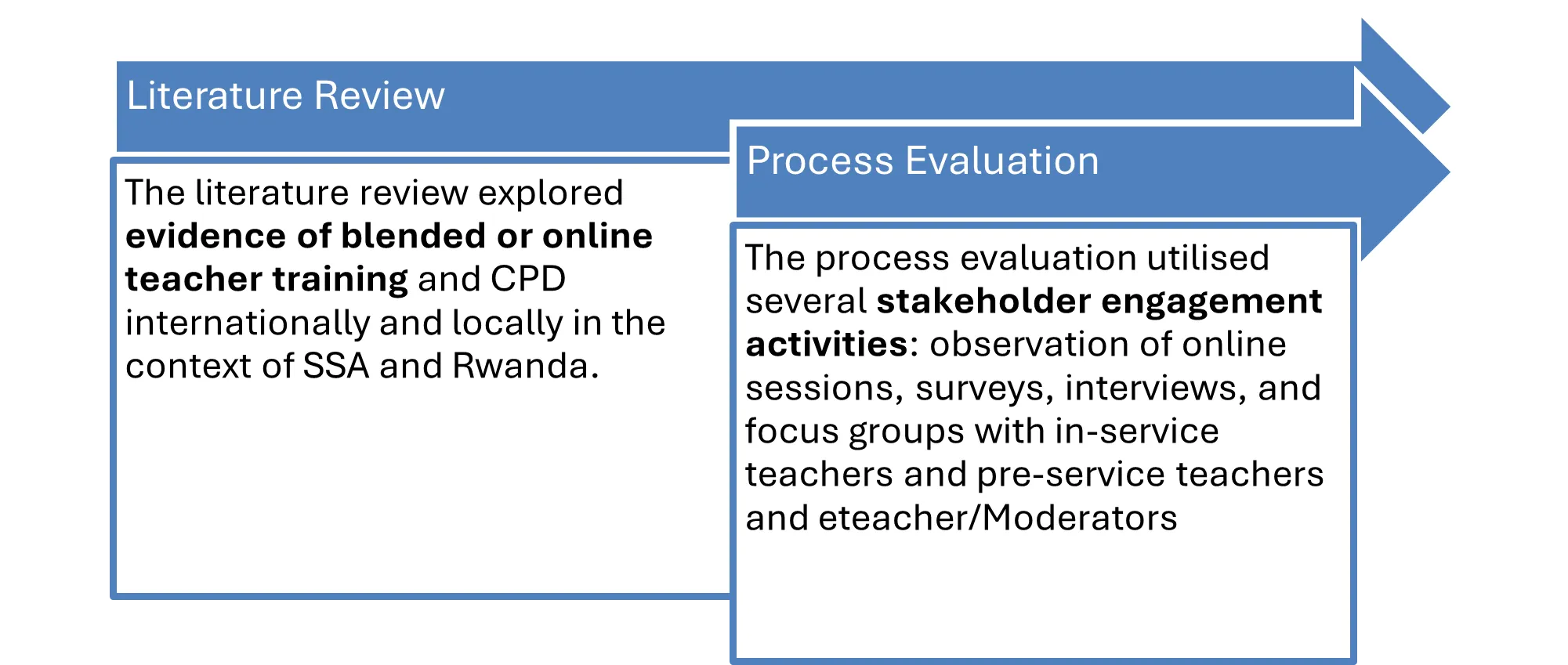
The study adopted a two-stage methodological approach. First, Ecctis conducted a literature review exploring evidence on blended and online teacher training and Continuous Professional Development (CPD) internationally and locally, with a particular focus on Rwanda and the wider Sub-Saharan African context. Second, Ecctis carried out a process evaluation through observations of online sessions, surveys, interviews, and focus groups with in-service and pre-service teachers, alongside eTeacher/Moderators delivering the online sessions. Data collection was undertaken in partnership with a research team from the Catholic University of Rwanda’s Faculty of Education.
Project outputs
The project produced two key deliverables: a commercial-in-confidence report presenting the findings and recommendations from the evaluation of STELIR, submitted to the British Council, and a journal article published in PRACTICE: Contemporary Issues in Practitioner Education.
The article explores in-service and pre-service teachers’ experiences of participating in STELIR’s online provision, with particular attention to women teachers and in-service teachers with disabilities. A focus on teachers with visual impairments was selected because visual impairment is the most prevalent disability type in Rwanda, according to information provided in the 2022 thematic report on the socio-economic characteristics of persons with disabilities, produced as part of the Fifth Population and Housing Census in Rwanda. The analysis was informed by gender studies theory, particularly Moser’s gendered triple role framework, and disability studies theory, particularly Oliver’s social model of disability. Together, these perspectives helped the study examine teachers’ experiences through both gender and disability lenses and share learning that can inform future inclusive teacher training initiatives.